


Everything you need to know about lumbar disc prolapse, often known as a slipped disc!
Did you know that over 95% of slip disc situations can be resolved without surgery? Even if surgery is required, it can now be performed with a greater than 98% success rate in a sophisticated, minimally invasive method while being monitored by neuromonitors.
Are any of the following issues affecting you?
- Pain in the low back Pain radiating into the legs from the back or buttocks A leg muscular soreness, searing pain, electric shock
- like pain, stabbing pain, or sharp shooting pain Leg numbness Leg heaviness Leg weaknessLeg soreness,
- weakness, or heaviness that occurs after walking a certain distance Sciatica
Then, we offer a sure, scientifically validated remedy for you.
Take These Easy Steps
- Step 1: Send a brief history of your problems and your X-ray and MRI images via WhatsApp. 9599428924
- Step 2: Consult Dr. Pramod Saini, senior consultant and head of spine surgery at Artemis Hospital in Noida , for expert advice.
- Step 3: Schedule at th Spine Surgery and Scoliosis in Noida. Call +91- 9599428924
- Step 4: Live a pain-free, disability-free life!
Please share the MRI/Xray report with us.
Sciatica: What is it?
When a patient comes to us with disc prolapse, sciatica, low back pain, numbness, or weakness in their legs, we first perform a thorough clinical evaluation of them. Patients’ detailed complaints are heard in order to ascertain how long they have been present, how frequently they occur, and how they have impacted the patients’ quality of life.Formally, we use the Oswestry Disability Index to determine a patient’s disability. The patient undergoes a thorough neurological examination to check for leg numbness or muscle weakness.
Physiotherapy and exercises are typically the initial line of treatment.
(For further information, visit our exercise page or YouTube channel.)
medications and lifestyle changes
(For further information, please visit our YouTube channel.)
However, some individuals still require surgery for disc prolapse, and it might be disastrous to postpone treatment in certain situations.
Which patients will require surgery to treat lumbar disc prolapse?
- Individuals who have weakness in any of the main leg muscles, such as the ankle muscles (e.g., ankle dorsiflexor weakness resulting in foot drop), knee muscles, hip muscles, etc.
- Lumbar disc prolapse-related numbness in the foot, buttock, or any other area of the leg
- Despite attempting conservative treatment for six weeks to three months, the patient still experiences excruciating sciatica pain.
- Frequent episodes of sciatica or low back pain that leave the patient bedridden (often more than three per year)
- Poor quality of life even after more than six months of conservative treatment is indicated by a severe Oswestry disability index.
- Urinary issues such as hesitation when urinating, a slowed stream of urine, frequent urination, and a sense of incomplete emptying
- Constipation and straining during bowel movements
- loss of control over bowel and urine movements
- Numbness around the genitalia or in the pelvic region
When is surgery necessary for lumbar disc prolapse patients?
Is spinal injection a viable treatment option for disc prolapse?
For disc prolapse, two types of spinal injections are administered.
- Facet injections: The facet joints of the spine experience some tension, subluxation, or irritation if the disc slips. Injections of steroids into these joints can provide short-term relief from back discomfort. The patient can have long-lasting pain relief if they develop their core muscles throughout this pain-free phase.
- Epidural injections: This treatment involves administering a local anesthetic and steroid medication to the irritated nerves. There is typically localized irritation surrounding the nerves whenever a disc slips and compresses them. The radiating discomfort may be lessened by using steroid medicine to reduce this inflammation. Either temporary or permanent pain alleviation is possible. Before choosing surgery, an epidural injection can be tried as long as there is no neurological impairment.
Spin Surgery Types
Microdiscectomy of the Lumbar Region
A 1 to 1.5 inch incision is made for a microdiscectomy, a minimally invasive spine operation. Under a microscope, the bone that is compressing over the nerve root or the disc beneath it is removed during this procedure, maintaining spinal stability while avoiding harm to the normal musculoligamentous joints and tissues.
Leg discomfort is more likely to be relieved by a microdiscectomy than back pain. Leg pain typically goes away right away following a microdiscectomy procedure, and patients typically return home the same day or the day after surgery with considerable pain relief. It typically takes a few weeks or months for a patient with leg weakness or numbness to get well, and some patients may not get better at all, particularly if surgery is performed too late after the weakness or numbness first appears. We typically perform dynamic x-rays of the spine prior to the surgery. These x-rays aid in the evaluation of spinal stability. For patients with leg discomfort as their primary complaint, minimal back pain, and no instability on dynamic x-rays, microdiscectomy is a very successful procedure.
A Slipped (Prolapsed) Disc: What Is It?
A group of bones called vertebrae are piled on top of one another to form the spinal column. There are discs between these bones that act as cushions. By serving as stress absorbers during routine motions like walking, lifting, and twisting, the discs shield the bones. Each disc is composed of two parts: the stiff outer ring (Annulus fibrosus) and the soft, gelatinous interior half (Nucleus pulposus).
Slipped discs are the result of an intervertebral disc of the spine losing its normal consistency and/or shape. The disc changes shape when its nucleus bulges or leaks out of its annulus. Herniated, ruptured, ripped, bulged, or projecting disc are among medical terms that might be used to describe a sliding disc.
What signs of a slipping disc are present?
From your neck to your lower back, any section of your spine may have a slipped disc. One of the more frequent locations for slipping discs is the lower back. Your spinal column is a complex system of blood vessels and nerves. Nerves and other surrounding structures may experience increased pressure as a result of a slipped disc.
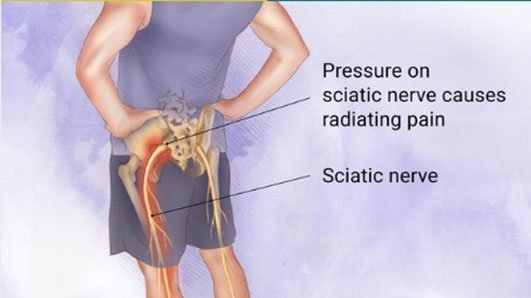
A slipped disc can cause the following symptoms:
- Most often, one side of the body experiences pain and numbness.
- discomfort that spreads to your lower or upper limbs
- discomfort that gets worse at night or when you move
- discomfort that gets worse after sitting or standing
- discomfort with short-distance walking
- Inexplicable weakness in the muscles
- burning, aching, or tingling in the limbs
- loss or change in feelings
- Problems managing bladder or bowel movements
Each person may experience different sorts of pain. If your discomfort causes tingling or numbness that impairs your ability to control your muscles, consult your physician.
What causes a sliding disc? What Are the Risk Factors and Causes of a Slipped Disc?
The following are the two most frequent reasons for a herniated or slipped disc:
- The nucleus pulposus weakens and becomes less hydrated with age due to natural disc degeneration.
- Disc trauma or injury can result from external factors like whiplash injuries or from carrying a large object with improper posture. particularly when combined with spinning or twisting; and excessive strain forces brought on by physical activity. Slipped discs are rarely caused by abrupt, severe acute trauma.
In some cases, it may be hard to pinpoint a specific reason.