Adolescent Idiopathic Scoliosis Surgery in Noida: Successful Correction of an 85° Spinal Curve to 10°
Dr. Pramod Saini | Scoliosis Surgeon in Noida | Max Super Speciality Hospital
Understanding Adolescent Idiopathic Scoliosis
Adolescent Idiopathic Scoliosis (AIS) is a three-dimensional deformity of the spine that commonly develops during adolescence, particularly during periods of rapid growth.
Parents often notice that one shoulder is higher than the other, the waist appears asymmetrical, the body is shifted to one side, or there is a prominent rib hump.
Early diagnosis is important because spinal curves may progress rapidly during growth spurts.
Case Study: A 12-Year-Old Girl with Severe Scoliosis
A 12-year-old girl was brought to us after her parents noticed progressive deformity of her back during a period of rapid height growth.
Clinical examination revealed:
- Right shoulder higher than the left
- Significant right-sided trunk shift
- Prominent rib hump
- Marked cosmetic deformity
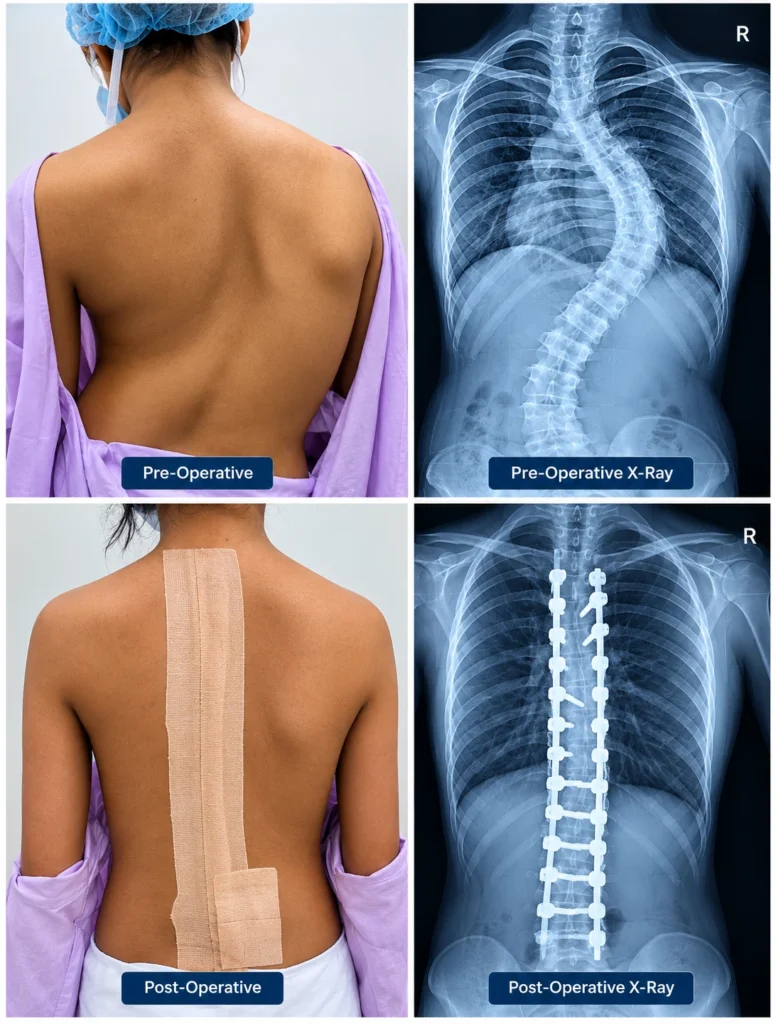
Her spinal X-rays revealed a severe thoracic scoliosis measuring approximately 85°.
An MRI of the spine was performed to exclude underlying intraspinal abnormalities. No significant anomaly was identified, and the patient was diagnosed with adolescent idiopathic scoliosis.
Why Was Surgery Delayed?
At initial presentation, the patient had attained menarche only six months earlier and still had meaningful skeletal growth remaining.
Although the curve was severe enough to warrant surgical consideration, the timing of definitive correction required careful planning.
After evaluating her growth status and deformity, we decided to use a Boston brace as an interim measure, with close monitoring.
The aim was to limit further curve progression while allowing additional skeletal maturation before definitive correction.
She underwent clinical assessment and periodic standing spinal radiographs, approximately every three months.
During this period, her curve remained relatively stable at approximately 85°.
Scoliosis Correction Surgery
At approximately 13½ years of age, the patient underwent single-stage posterior scoliosis correction surgery.
The procedure included:
- Posterior spinal instrumentation from T4 to L3.
- Navigation-guided pedicle screw placement.
- Multilevel Ponte osteotomies to improve spinal flexibility.
- Differential rod correction technique.
- Continuous intraoperative neuromonitoring to monitor neurological function.
The objective was not simply to straighten the spine but to achieve balanced shoulders, improve trunk alignment, correct rotational deformity, and obtain a stable correction.
Surgical Outcome: 85° to 10°
Following surgery, the main spinal curve improved from approximately 85° to 10°.
The patient achieved substantial correction of the deformity, restoration of shoulder balance, improvement in trunk alignment, and marked reduction in the rib hump.
At one-year follow-up, she was walking comfortably and participating in routine activities, including dancing, running, jumping, and sports.
When Does Adolescent Scoliosis Require Surgery?
Treatment depends on curve magnitude, skeletal maturity, remaining growth, curve progression, and spinal balance.
As a general guide:
- Less than 25°: Observation and periodic follow-up for many patients.
- Approximately 25–45°: Bracing is commonly recommended when meaningful skeletal growth remains.
- Approximately 45–50° or greater: Surgical correction may be considered, particularly for progressive curves.
These are general guidelines, not absolute rules. Individual treatment decisions must consider the entire clinical picture.
Why Is Surgical Planning Important?
Scoliosis correction is among the more technically demanding procedures in spine surgery.
The surgeon must carefully determine the appropriate timing, levels of fusion, degree of correction, and techniques needed to achieve long-term spinal balance.
Modern techniques such as navigation-guided instrumentation, Ponte osteotomies, and intraoperative neuromonitoring can assist in the precision and safety of complex deformity correction.
Consult a Scoliosis Surgeon in Noida
Dr. Pramod Saini is an experienced orthopaedic spine surgeon with over 15 years of experience in spine surgery, including complex spinal deformity correction, minimally invasive spine surgery, and endoscopic spine procedures.
Dr. Pramod Saini
Associate Director, Orthopaedic Spine Surgery
Max Super Speciality Hospital, Sector 128, Noida
Appointments: 9599428924
Patients seeking evaluation for adolescent scoliosis, spinal deformity, uneven shoulders, or a rib hump can consult for a detailed assessment and individualized treatment plan.
Clinical images shared with appropriate patient/guardian consent. Individual surgical outcomes may vary.