
Can Spine Surgery Be Performed in Elderly Patients?
A common concern among families is whether spine surgery can be performed safely in elderly patients, especially when the patient also has medical conditions such as heart disease or Parkinson’s disease.
Age certainly matters, but it is not the only factor. With modern minimally invasive spine surgery, careful anaesthesia assessment and appropriate patient selection, Doctors may consider surgery even in elderly patients when the expected benefits outweigh the risks.
75-Year-Old Patient With a Burst Fracture
A 75-year-old gentleman with Parkinson’s disease and cardiac comorbidities suffered a fall at home and developed severe back pain.
Because of the intensity of his pain, doctors admitted him to the hospital. MRI of the spine showed a burst fracture that compressed the nerves. Fortunately, despite the radiological compression, his neurological function was preserved.
Considering his age and medical history, the medical team initially tried conservative treatment. However, persistent pain made mobilization difficult.
This created another concern: prolonged bed rest in elderly patients is undesirable whenever safe mobilization can be achieved, because immobility can contribute to deconditioning and other medical complications.
Why Minimally Invasive Fixation Was Chosen ?
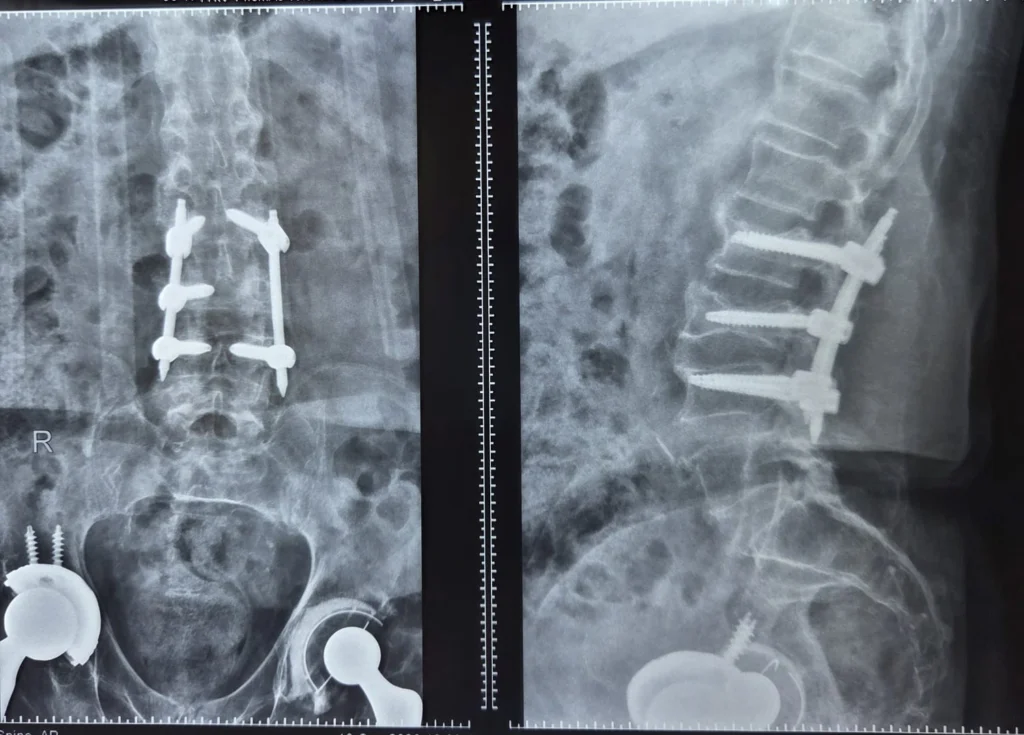
Following medical and surgical evaluation, Dr. Pramod Saini performed minimally invasive spinal fracture fixation at Max Super Speciality Hospital, Noida.
Minimally invasive spine surgery aims to stabilize the spine while reducing disruption to the surrounding muscles and soft tissues.
Following surgery, the patient was able to mobilize within two days. At his three-month follow-up, he had recovered well and was comfortable.
Modern Spine Surgery and the Elderly
The objective of treating a spinal fracture in an elderly patient is not simply to treat an MRI or X-ray. The broader goal is to control pain, protect neurological function, restore spinal stability when required and enable safe mobilization.
Advances in minimally invasive spine surgery, anaesthesia and postoperative rehabilitation now allow doctors to consider surgical treatment for selected elderly patients who previously might have faced prolonged immobilization.
At the same time, treatment must always be individualized. Doctors can successfully treat some fractures without surgery, while unstable fractures, persistent disabling pain, progressive deformity or neurological compression may require surgical evaluation.
If an elderly family member develops severe back pain after a fall, particularly when the pain prevents standing or walking, an early spine evaluation and appropriate imaging can help doctors establish the diagnosis and guide treatment.
Dr. Pramod Saini
Orthopaedic Spine Surgeon | Minimally Invasive & Endoscopic Spine Surgery
Max Super Speciality Hospital, Noida