Late Neurological Deterioration -Tubercular Kyphosis: The Role of Internal Gibbectomy
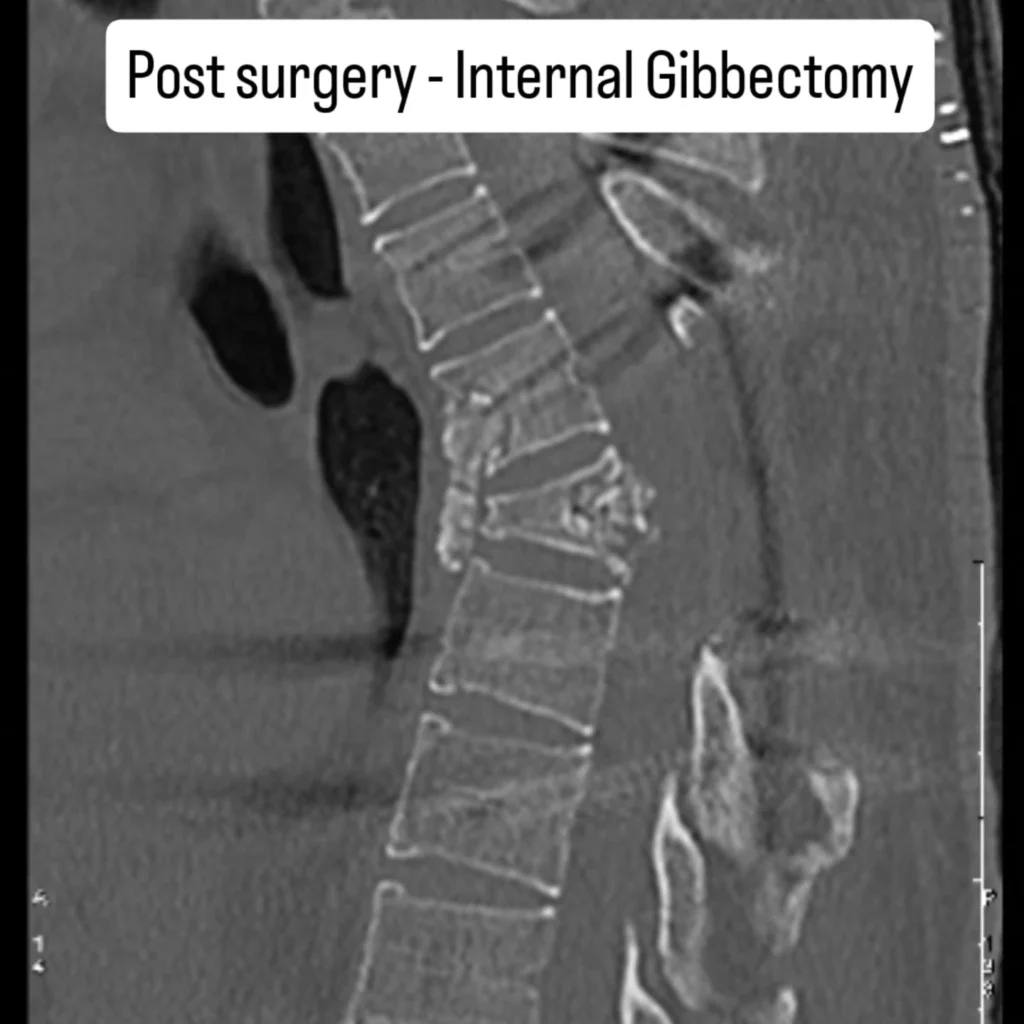
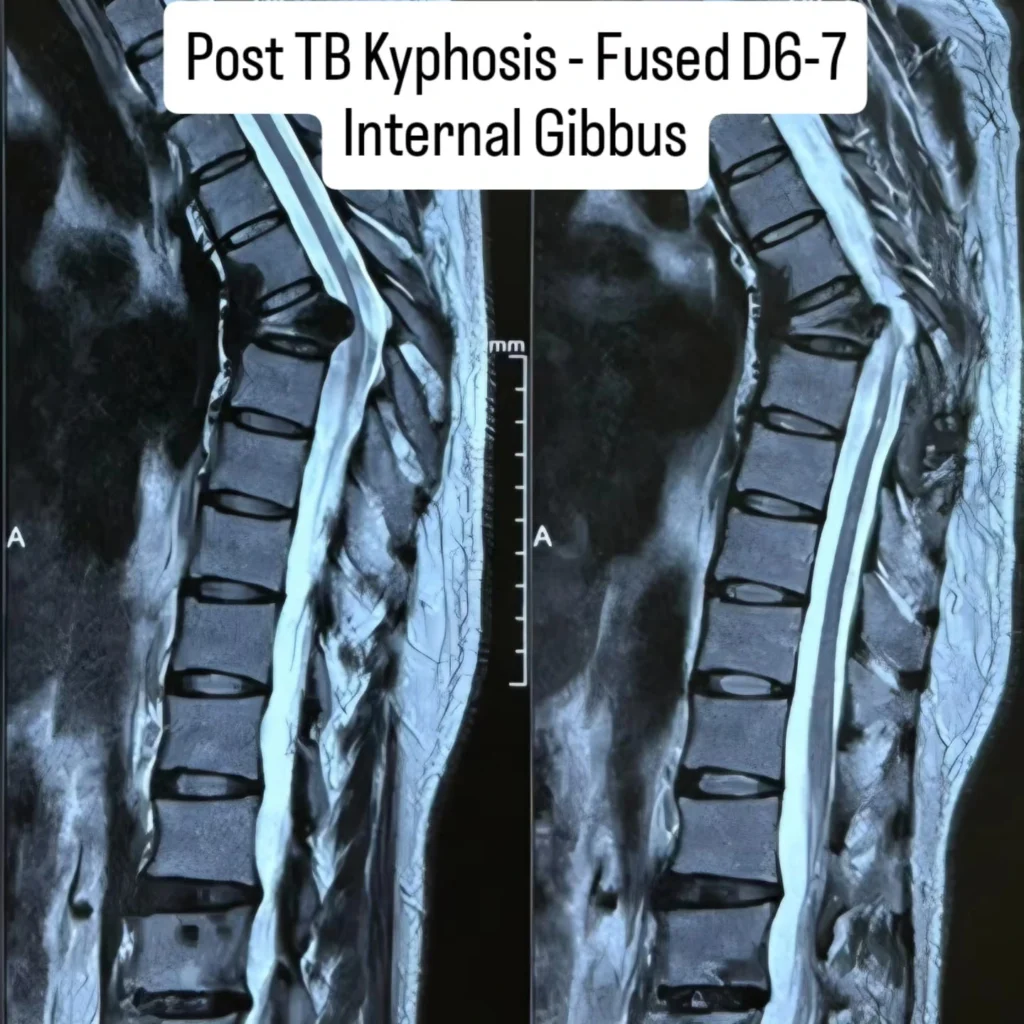
Severe post-tubercular kyphosis can occasionally cause neurological deterioration many years after the active infection has healed. A prominent internal gibbus can compress an already stretched and compromised thoracic spinal cord, producing progressive myelopathy and difficulty walking.
A recent case illustrates this problem.
A 40-year-old man had been treated for MDR spinal TB involving D6–D7 seven years earlier. He underwent left-sided costotransversectomy without fixation at another centre. Although the infection was drained, the angular deformity remained.
Following a stormy postoperative course with paraplegia, sepsis, pneumothorax, AKI and ventilatory support, he gradually recovered. With prolonged ATT and rehabilitation, his neurological function improved sufficiently for him to walk with a stick and return to work.
For several years he remained stable. However, six months ago, he again developed progressive imbalance, heaviness of the legs and difficulty walking.
CT and MRI demonstrated a severe angular kyphosis with an internal gibbus causing thoracic spinal cord compression at D6–D7. Importantly, the anterior column was already solidly fused.
Choosing Decompression Over Aggressive Correction
Modern spine surgery allows major deformity correction using advanced posterior instrumentation and vertebral column resection techniques. However, aggressive correction of a rigid deformity is not necessarily appropriate for every patient—particularly when the spinal cord is already compromised.
In this case, a posterior internal gibbectomy with posterior instrumentation was performed using a posterior VCR-type approach. Bilateral transpedicular decancellation created sufficient space to carefully push the internal gibbus anteriorly and decompress the spinal cord without rib excision or aggressive correction of the deformity.
The patient noticed improvement in leg heaviness within 48 hours and started mobilizing with an improved gait.
An Old Principle with a Selective Modern Role
Internal gibbectomy remains relevant in carefully selected cases of healed spinal tuberculosis with severe angular kyphosis and late-onset neurological deterioration.
Modern spine surgery is not simply about achieving maximum deformity correction. The surgical strategy should be individualized according to the pathology, neurological status and risk to the spinal cord.
Sometimes the best correction is not maximum correction—but the safest possible decompression.
Dr. Pramod Saini
Orthopaedic Spine Surgeon, Noida